

Practice Planning
March 12th, 2025 | Season 10 Edition 7

As we continue to look for ways to help lacrosse in the Carolinas grow and improve, we wished to take a different approach to The Scoop this Spring. Over the next few weeks, our goal is to provide a number of resources that coaches can use to develop their players and teams throughout the season. For parents and players that read The Scoop, we hope that this content gives you a better understanding of how practices or development sessions are constructed, the thought that goes into development and everything we do with Team 91 including why certain drills are used.
The first thing we do before every practice or training session is write up a practice plan. This is essentially our schedule for the practice and lays out what we are going to do, and what we hope to accomplish. For some programs, we’ll draft up the entire season before it starts. For some, we will plan out a few weeks at a time and for others we’ll take a day-to-day approach. In general, the most common practice is to plan out a month at a time. I’ll elaborate on why below. The most important part is that we are planning out each practice and it’s not just some notes on a napkin.
You can see an example of one of our practice plans below.
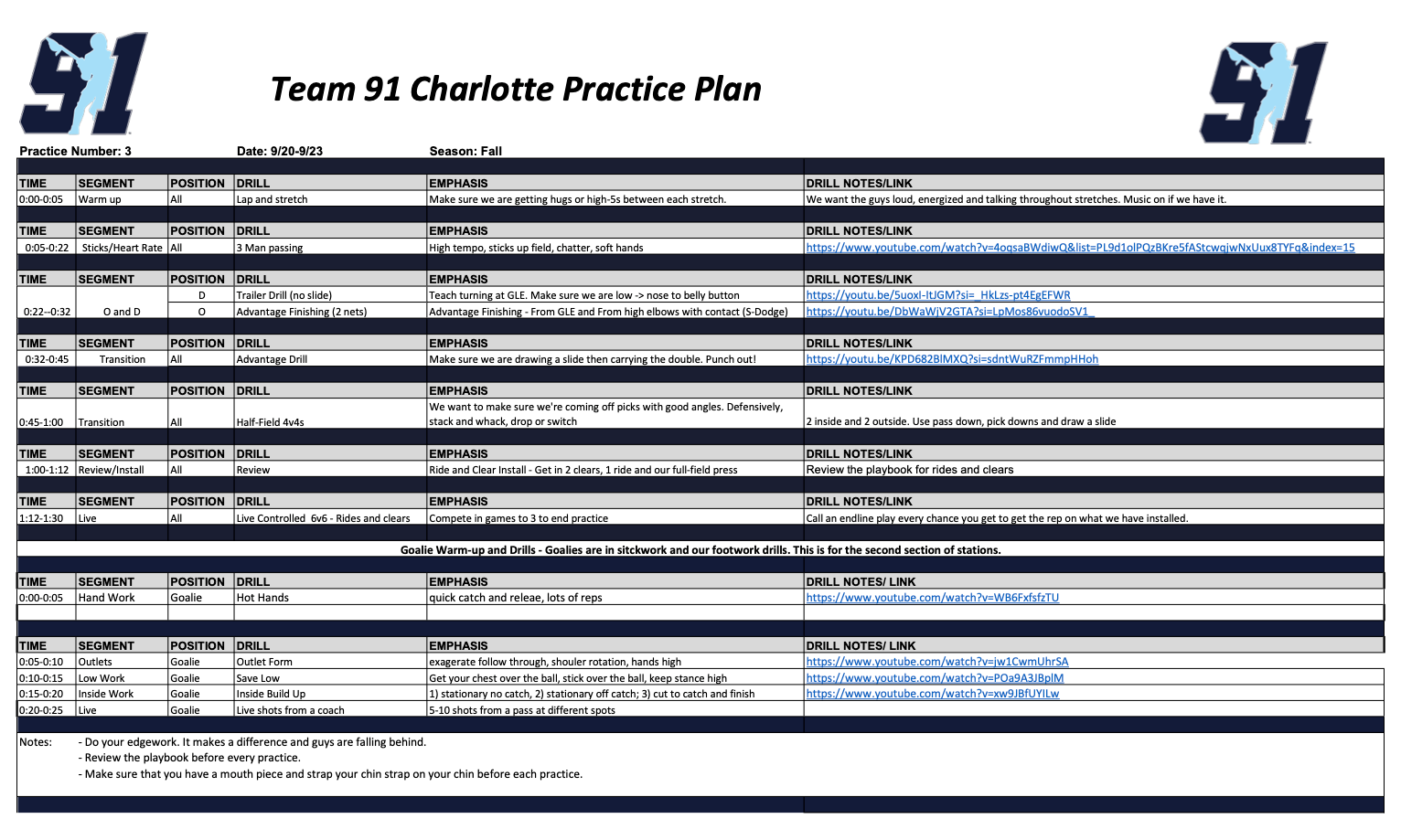
If you’re a coach (in any sport), please feel free to use this template! We’re happy to provide it.
Breaking down each part of the plan:
We start by identifying the date and the number. I find the practice number really helpful because it gives me an idea of how far along the season or program we are. When we get to practice number 10, our players should know what tight line drills are, what triple-threat means, etc. so we don’t need as much time explaining that. In our first practice we may need to take more time on teaching the drill or skill.
Each portion of practice is broken down by time, segment, position, drill, emphasis then drill notes or a link to a video of the drill.
Time: This identifies how long we will do a drill. In general, we really try to avoid doing the same drill for more than 20 minutes. The sweet spot is in the 10-15 minute range but as we add more numbers or get into 6v6 or full field situations, we may go for a little longer. If we do a small-sided drill or stick work for longer than 20 minutes, players start to lose their focus and put less effort into that specific drill. A change helps energize the players and keep practice intensity higher.
Segment: This helps identify what portion of practice or the training session we are in. It also allows us to cover the core areas. Each practice will include a stick work segment, ground balls or transition, a positional segment then one or multiple “compete” segments. These competing segments are usually 3v3, 4v4, 5v5, 6v6, etc. I am not a fan of 1v1s so you will rarely see those in our plans unless it is a modified version. Some drills can be used in multiple segments but on different days (never the same days!). For example, we may use West Genny as our stick work drill or we may use it as a transition drill. We could also use a modified version for groundballs.
Position: This identifies what each position group is doing in a certain drill. This can be split by A/M/D/G/FO, Offense and Defense, all, etc. depending on what the segment of practice calls for.


Drill: This is clear, identifying what drill we are doing in that segment of practice. One way I have changed and developed over the years is by trying to use a lot of different drills. Early on in my coaching career, I would usually start every practice with the same warm up and stick work, then we would change the middle of practice based on what we wanted to accomplish, then we would finish with a 6v6 type scenario. While the schedule and segments have not changed much, we are doing a lot of different drills. The reason we try to plan practices out 1-2 months at a time is to avoid doing the same drills over and over. If you plan day-to-day, you sometimes forget the last time you ran a certain drill. When we plan a month at a time, we can be a little bit more deliberate in making sure our players are getting a variety of different drills. While there may be the same 5-6 drills we use for stick work a lot, we are rarely going to do them on back to back practice days. This allows us to avoid getting stagnant and keeps our players a little more engaged in everything we do.
Emphasis: What do we want to accomplish in each drill we do? This serves as a reminder for our coaches of what we want to focus on with each drill. At times, it may look similar to our drill notes (next) but it serves as a reminder of what coaches should be looking for with each segment. In stickwork, we may want to focus on keeping the stick at our shoulder or we may want to focus on hip passes. In our 4v4s, we may want to focus on starting with a 1v1 dodge, we may want to start with a pick or slip or even put constraints on who can dodge and who shouldn’t.
Drill Notes/Link: When possible, we always try to provide a YouTube link to the drill we want to do. Ideally, these videos are no more than two minutes long. If a coach is in his car before practice or even standing on the field during a water break, they can watch the quick link on their phone and have an idea of exactly what the drill should look like. If we don’t have a YouTube video of a specific drill, or we’re modifying something we normally do, we can place the notes for that in this part of the plan.
At the bottom of the plan you can see our goalie warm-up planned out separately. A huge pet peeve of mine is watching coaches just firing shots on a goalie from 10-15 yards out. It’s a quick way to drive kids away from the position, specifically early in their playing careers. We wouldn’t warm up other positions with such little thought and we certainly shouldn’t be doing it with goalies. The plans we lay out include shots to specific locations, hand work, outlets, footwork, etc. rather than just a coach rifling shots with no real strategy. It’s a small thing that can make a big difference over time.
At the bottom of the plan we can lay out any notes we have. This usually includes stuff like “make sure you do your edge work”, “review the playbook”, or “remember practice is at 6:00PM tomorrow.”
Over the next few editions of The Scoop, we are going to go into more detail about some of our favorite drills with the “what” and “why” around our practices and training sessions.
Enjoy,
Ryan Flanagan